


[日本語] / [English]
Intelligence Science and Technology Course, Graduate School of Informatics, Kyoto University

Prof. Kurohashi was selected as ACL Fellows 2025. †The following paper won the Best Paper Award in the AAAI 2026 AI Alignment Track. †
We will present the following papers at EACL 2026 (2026/3). †
We will present the following paper at AAAI 2026 (2026/1). †
The following presentations and roles are scheduled for AACL 2025 (2025/12) †
|
We will present the following papers at EMNLP 2025 (2025/11). †
|
Language is the most reliable medium of human intellectual activities. Our objective is to establish the technology and academic discipline for handling and understanding language, in a manner that is as close as possible to that of humans, using computers. These include syntactic language analysis, semantic analysis, context analysis, text comprehension, text generation and dictionary systems to develop various application systems for machine translation and information retrieval.
Search Engine Infrastructure based on Deep Natural Language Processing †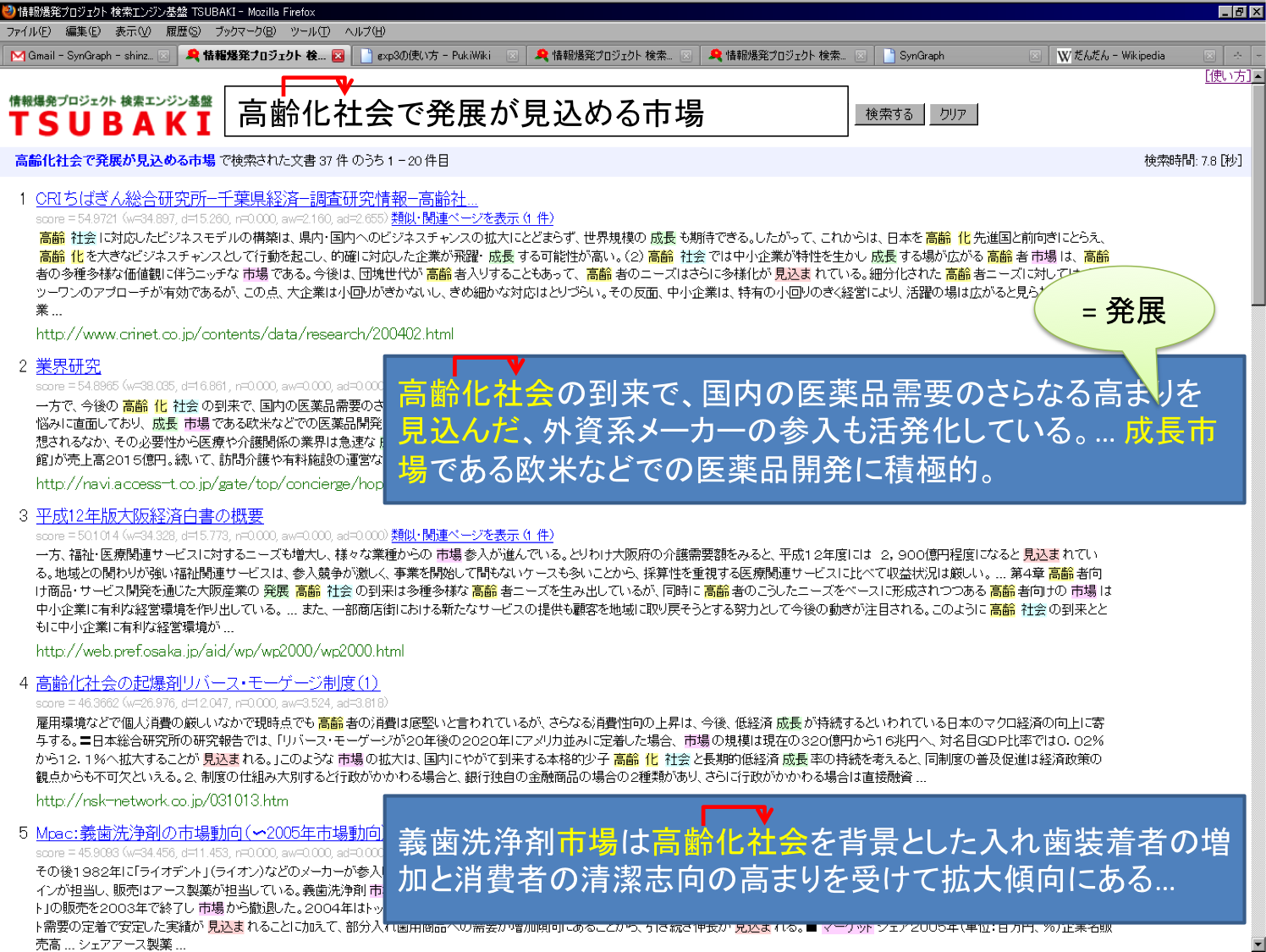 The essential purpose of information retrieval is not to retrieve just a relevant document but to acquire the information or knowledge in the document. We have been developing a next-generation infrastructure of information retrieval on the basis of the following techniques of deep natural language processing: precise processing based not on words but on predicate-argument structures, identifying the variety of linguistic expressions and providing a bird's-eye view of search results via clustering and interaction. |
Machine Translation †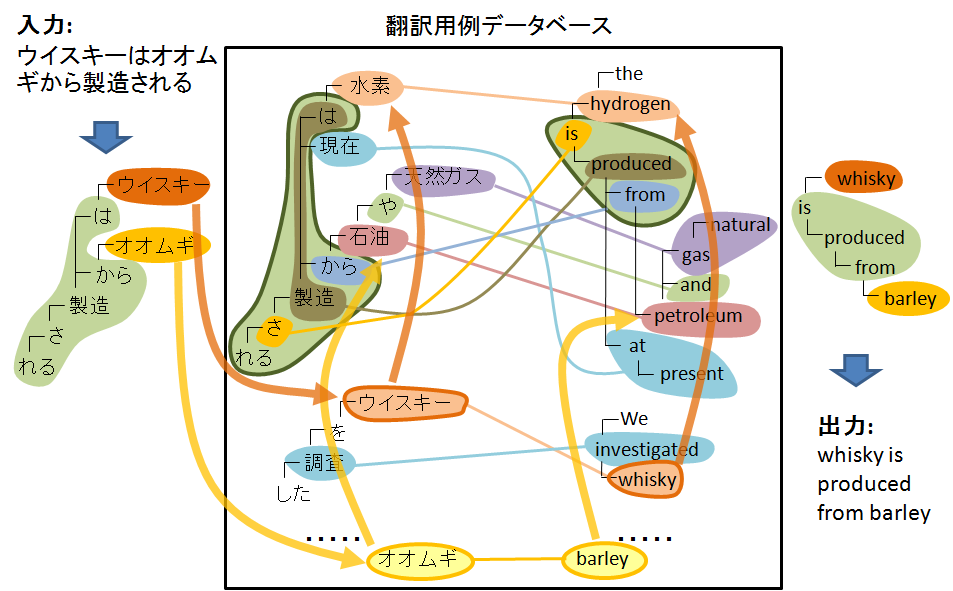 To bring automatic translation by computers to the level of human translation, we have been studying next-generation methodology of machine translation on the basis of text understanding and a large collection of translation examples. We have already accomplished practical translation on the domain of travel conversation, and constructed a translation-aid system that can be used by experts of patent translation. |
To make computers understand language, it is essential to give computers world knowledge. This was a very hard problem ten years ago, but it has become possible to acquire knowledge from a massive amount of text in virtue of the drastic progress of computing power and network. We have successfully acquired linguistic patterns of predicate-argument structures from automatic parses of 7 billion Japanese sentences crawled from the Web using grid computing machines. By utilizing such knowledge, we study text understanding, i.e., recognizing the relationships between words and phrases in text.
Prof. Kurohashi does not supervise new students. Assoc. Prof. Murawaki or Assoc. Prof. Chu will be responsible for supervising their research.
 daimonzi_20241127.jpg 868 download
[Information]
daimonzi_20241127.jpg 868 download
[Information]
 trip_20230913.jpg 731 download
[Information]
trip_20230913.jpg 731 download
[Information]
 manshuin_20211117.jpg 434 download
[Information]
manshuin_20211117.jpg 434 download
[Information]
 covid-19_banner.en.png 267 download
[Information]
covid-19_banner.en.png 267 download
[Information]
 TSUBAKI.png 1757 download
[Information]
TSUBAKI.png 1757 download
[Information]
 EBMT.png 1684 download
[Information]
EBMT.png 1684 download
[Information]


